Wireless classical guitar sound
In preparation for my concerts I developed a wireless transducer system for classical guitar that can replace microphone and eliminate acoustic feedback. The system does not require any guitar modification .
The usb-rechargeable prototype system costs less than $100 and works nicely with my rechargeable 40W guitar amp, allowing me to play classical guitar with amplification without microphone and without access to a power point.
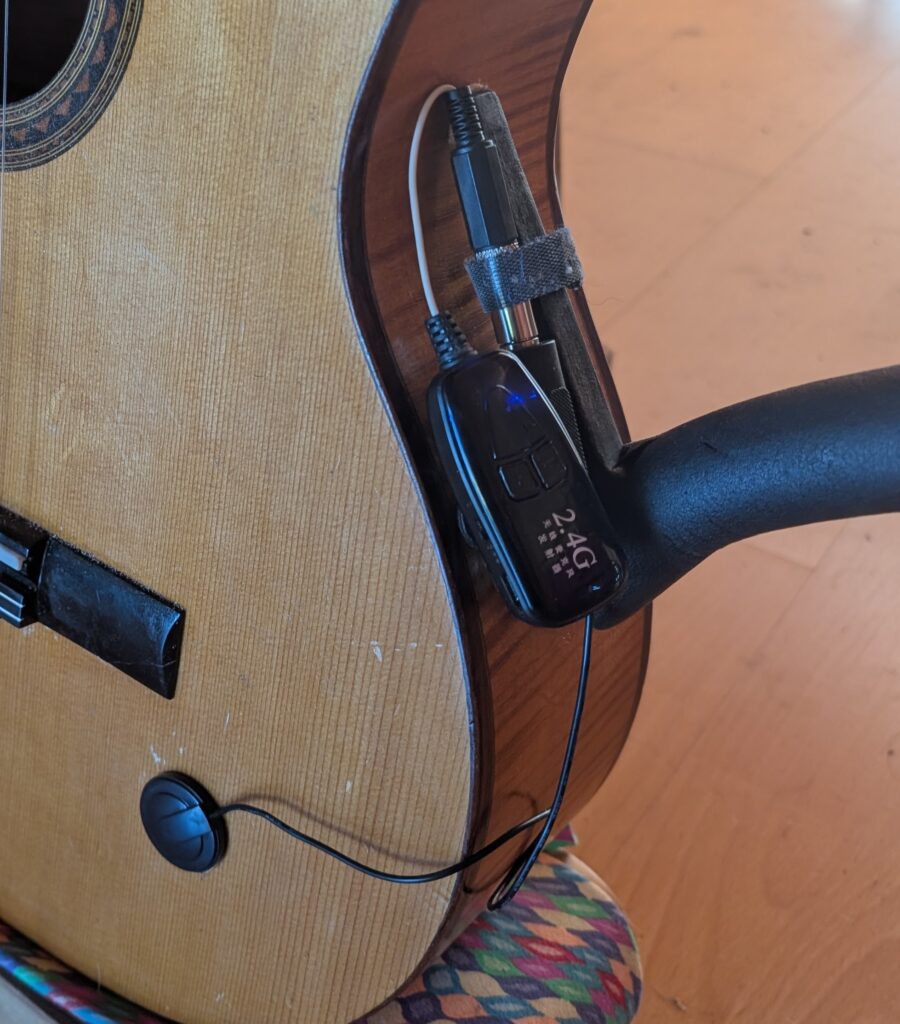
The sound sensor is attached to the guitar soundboard using removable double-sided tape. The 2.4G wireless transmitter is attached to the guitar leg support with a Velcro strip. I can easily transfer the system from one guitar to another.
The transmitter provides 4 basic functions: power on/off, mute, volume up, and volume down. This is sufficient for most performance situations.
By choosing the location of the sound sensor on the soundboard, I can optimize the amplified sound. Knowing the shapes of the fundamental modes of vibration of the guitar top (its eigenvectors) is helpful in making this choice.
Typically, piezoelectric sound sensors are more sensitive to the higher-frequency (treble) string vibrations than to the lower-frequency (bass) ones. For this reason, to achieve a reasonably strong electrical signal from all strings, it is advisable to locate the piezoelectric sound sensor near the bridge, where the vibration amplitude of the guitar top at low frequencies is greatest. This can be explained using the hologram presented below.
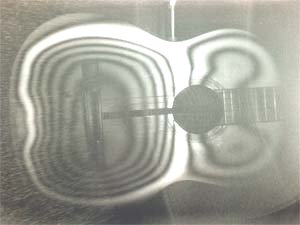
Hologram of the first mode shape of vibration (the first eigenvector) of my Rudolf Klier guitar. This mode corresponds to the lowest resonance frequency of the guitar body. The brightest areas are “nodes,” where the guitar top does not vibrate. The dark fringes connect points vibrating with exactly the same amplitude. The hologram reveals that the maximum vibration amplitude at the guitar’s lowest natural frequency occurs near the bridge. Different guitars may have different resonant frequencies, but the lowest mode shape is essentially very similar for all classical guitars.
Optimal location of the piezoelectric sound sensor in the vicinity of the bridge depends on higher resonances of guitar body and corresponding higher mode shapes (higher eigenvectors), which in turn depend on guitar construction details such as bracing, dimensions and materials. I experiment with several candidate locations of the sensor until the amplified sound seems nice across guitar registers.
I have compared performance of my wireless system with performance of a high-quality microphone system, using the same amplifier in both cases. The following summarizes my observations.
My system vs. microphone
- A microphone picks up the sound radiated by the guitar from a distance. My system senses the vibrations of the guitar soundboard at a single, carefully chosen location. Choosing this location lets me optimize the amplified sound.
- With a microphone, the amplified sound depends on the position of the guitar relative to the microphone. This dependence decreases as the distance increases, but a greater distance requires higher microphone gain, which raises the risk of acoustic feedback (amplified sound re-entering the microphone and creating a sound instability). Placing and adjusting a microphone can therefore be challenging.
- Unlike a microphone, my system is independent of the guitar’s position during performance, giving the performer complete freedom of movement.
- A microphone picks up all the surrounding sound, not just the sound of the guitar.
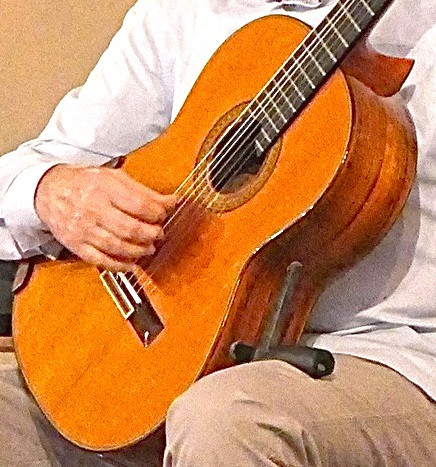
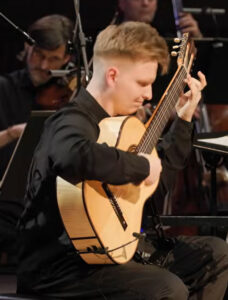
This creates a challenge when the guitar plays with an orchestra. The classical guitar is quieter than the other orchestral instruments, so its sound should be amplified to balance the orchestra. Placing a microphone very close to the guitar helps achieve this. For this reason, an award-winning guitarist Mateusz Kowalski (see photo) performs and records with a microphone attached directly to his guitar.
My soundboard sensor system, in contrast, is not sensitive to ambient sound such as that of an orchestra, so the amplification of the guitar is independent of the orchestra’s volume. This makes it easier to balance the classical guitar with the orchestra.
- My system is much easier to set up consistently and reliably than a microphone system.
- My system greatly reduces the risk of acoustic feedback, allowing higher sound amplification than is typically possible with a microphone.
- My system is completely wireless. A high-quality microphone system normally requires cables and, in many cases, pre-amps and external power.
- While my system is very convenient for live classical guitar performances, a quality microphone system is better for recording classical guitar music.
Low volume amplification
Classical guitar performances usually require only modest sound amplification that preserves the instrument’s natural timbre.
When I play in a quiet venue for an audience of 50–80 people, I use amplification primarily to improve the room acoustics by adding a small amount of reverb, simulating the acoustic characteristics of a well-designed concert hall.
The amplification is carefully adjusted so that the audience hears primarily my guitar, with the amplifier used mainly to facilitate the reverb effect. I use the equalizer on my guitar amplifier to reduce the volume of the higher frequencies.
Audio experts in the audience are often intrigued by the presence of a guitar amplifier behind me, with its speaker facing the back wall, because they cannot hear the amplifier during my performance.
For this type of low-volume sound amplification, my system performs as well as a high-quality microphone while being much simpler and faster to set up.
High volume amplification
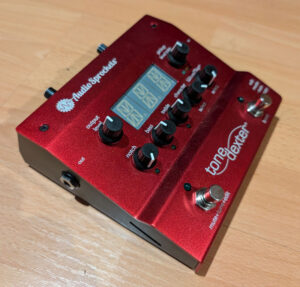
For high-volume amplification, as required for outdoor festivals and similar events, I use ToneDexter by Audio Sprockets to interface my wireless system with the stage equipment.
ToneDexter uses digital signal processing (DSP) to correct the spectral characteristics of the signal from a guitar’s piezoelectric pickup in real time during performance.
The system is calibrated for a specific guitar and pickup configuration by comparing the electrical output of the piezoelectric pickup with the electrical signal produced by a high-quality microphone.
This makes the amplified sound corrected by ToneDexter closely resemble the natural sound of the guitar as captured by a high-quality microphone.
The better the guitar’s acoustic properties, the more natural the resulting amplified sound corrected by ToneDexter.
ToneDexter
Of course I can use ToneDexter also for low-volume amplification scenarios, but my strategy is simplicity. I avoid using ToneDexter unless it becomes necessary.
Guitar-mounted microphone system
I have also tested my own version of a guitar-mounted microphone system, in the style of Mateusz Kowalski’s. My version is wireless and the microphone "stand" is attached to the side of the guitar with removable self-adhesive tape or velcro. The position of the microphone over the soundboard is adjustable. See photos below.
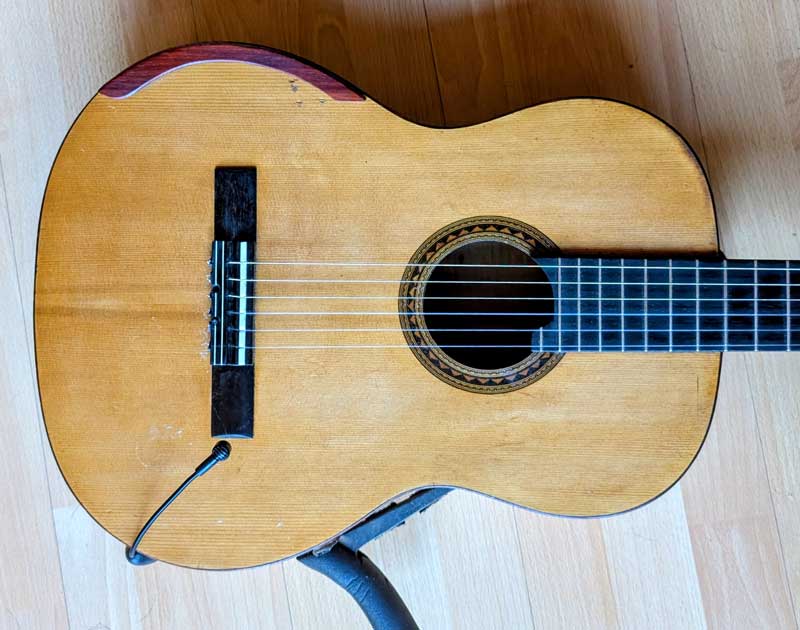
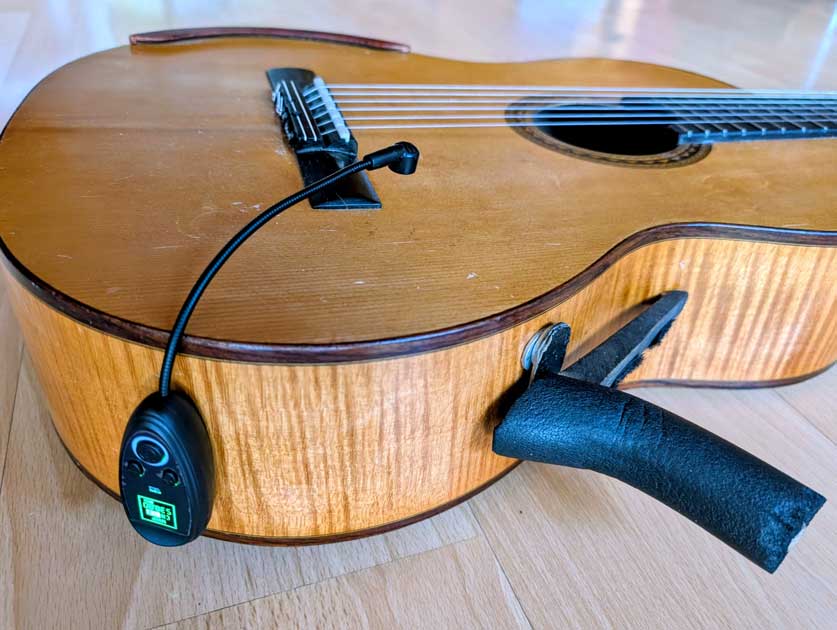
My wireless version of the guitar-mounted microphone
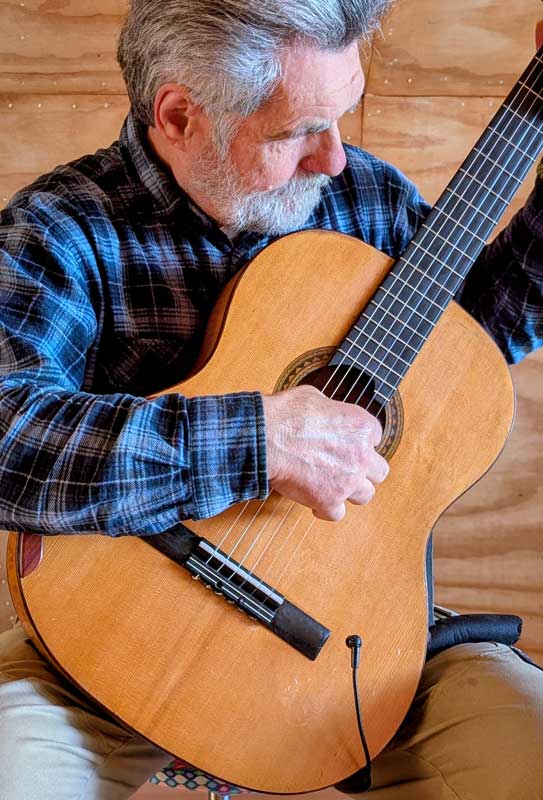
My tests suggest that this system works very well for medium-level amplification, provided that the loudspeaker faces away from the guitar. Compared with a conventional microphone at a distance, it offers wireless connectivity, lower sensitivity to ambient sound and a lower risk of acoustic feedback, which makes it suitable for playing guitar with an orchestra.
A guitar-mounted wireless microphone is very simple to install, and it seems to reproduce the timbre of the guitar more faithfully than an uncompensated soundboard sensor (one used without a tone-correcting pre-amp such as the ToneDexter).
A further advantage over a soundboard sensor is that nothing is attached to the soundboard, the most delicate part of a classical guitar.
The disadvantage of the microphone over the soundboard sensor is that microphone is sensitive to wind, which may be an issue in open-air performances.
The transmitter (mounted on guitar side) provides 4 basic functions: power on/off, mute, volume up, and volume down. This is sufficient for most performance situations.