Wireless classical guitar sound
In preparation for my concerts I developed a wireless transducer system for classical guitar that can replace microphone and eliminate acoustic feedback. The system does not require any guitar modification .
The usb-rechargeable prototype system costs less than $100 and works nicely with my rechargeable 40W guitar amp, allowing me to play classical guitar with amplification without microphone and without access to a power point.
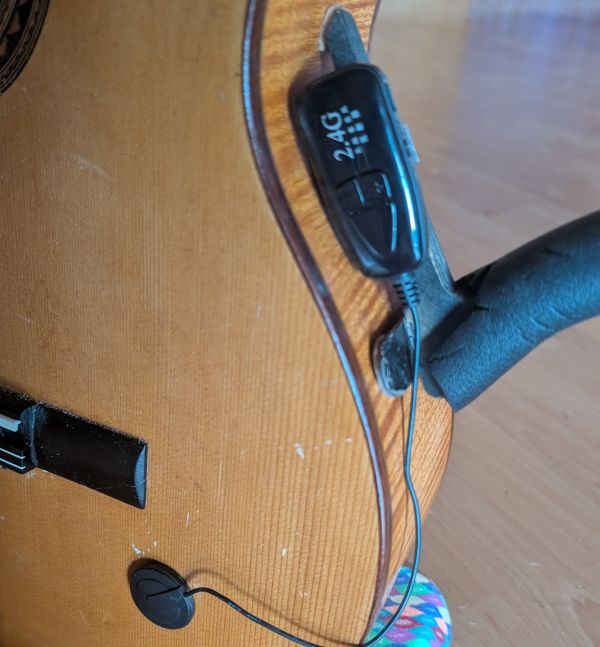
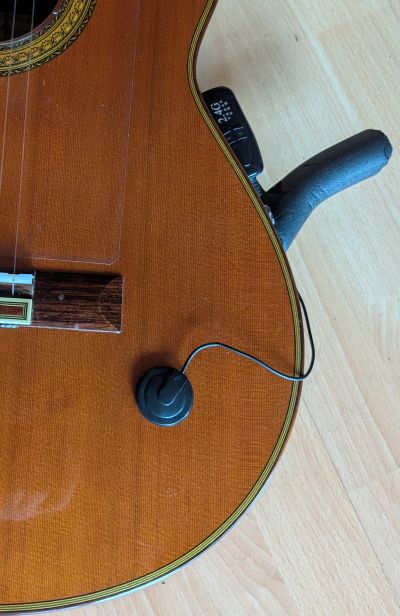
The sound sensor is attached to the guitar soundboard using removable double-sided tape. The 2.4G wireless transmitter is attached to the guitar leg support with a Velcro strip. I can easily transfer the system from one guitar to another.
The transmitter provides 4 basic functions: power on/off, mute, volume up, and volume down. This is sufficient for most performance situations.
By choosing the location of the sound sensor on the soundboard, I can optimize the amplified sound. Knowing the shapes of the fundamental modes of vibration of the guitar top (its eigenvectors) is helpful in making this choice.
Typically, piezoelectric sound sensors are more sensitive to the higher-frequency (treble) string vibrations than to the lower-frequency (bass) ones. For this reason, to achieve a reasonably strong electrical signal from all strings, it is advisable to locate the piezoelectric sound sensor near the bridge, where the vibration amplitude of the guitar top at low frequencies is greatest. This can be explained using the hologram presented below.
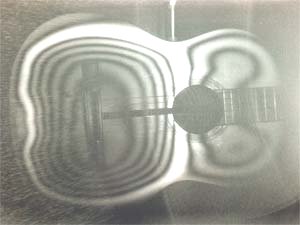
Hologram of the first mode shape of vibration (the first eigenvector) of my Rudolf Klier guitar. This mode corresponds to the lowest resonance frequency of the guitar body. The brightest areas are “nodes,” where the guitar top does not vibrate. The dark fringes connect points vibrating with exactly the same amplitude. The hologram reveals that the maximum vibration amplitude at the guitar’s lowest natural frequency occurs near the bridge. Different guitars may have different resonant frequencies, but the lowest mode shape is essentially very similar for all classical guitars.
Optimal location of the piezoelectric sound sensor in the vicinity of the bridge depends on higher resonances of guitar body and corresponding higher mode shapes (higher eigenvectors), which in turn depend on guitar construction details such as bracing, dimensions and materials. I experiment with several candidate locations of the sensor until the amplified sound seems nice across guitar registers.
I have compared performance of my wireless system with performance of a high-quality microphone system, using the same amplifier in both cases. The following summarizes my observations.
My system vs. microphone
- A microphone amplifies the sound radiated by the guitar from a distance. My system amplifies the acoustic vibrations of the guitar soundboard at a single, carefully chosen location. Selecting this location allows the amplified sound to be optimized.
- With a microphone, the amplified sound depends on the position of the guitar relative to the microphone. This effect becomes less significant as the distance between the guitar and the microphone increases. However, increasing this distance usually requires a higher microphone gain, which increases the risk of acoustic feedback.
Microphone placement and adjustment can be challenging in some situations.
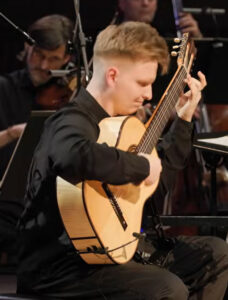
For this reason Mateusz Kowalski ( see photo) performs and records with a microphone actually attached to his guitar.
- My system is independent of the guitar's position during performance, giving the performer complete freedom of movement.
- My system is much easier to set up in a consistent and reliable way than a microphone system.
- My system greatly reduces the risk of acoustic feedback, allowing higher sound amplification than is typically possible with a microphone system.
- My system is completely wireless. A high-quality microphone system normally requires cables and, in many cases, pre-amps as well as external power
- While my system is very convenient for live classical guitar performances, a quality microphone system is better for recording classical guitar music.
Low volume amplification
Classical guitar performances usually require only modest sound amplification that preserves the instrument’s natural timbre.
When I play in a quiet venue for an audience of 50–80 people, I use amplification primarily to improve the room acoustics by adding a small amount of reverb, simulating the acoustic characteristics of a well-designed concert hall.
The amplification is carefully adjusted so that the audience hears primarily my guitar, with the amplifier used mainly to facilitate the reverb effect. I use the equalizer on my guitar amplifier to reduce the volume of the higher frequencies.
Audio experts in the audience are often intrigued by the presence of a guitar amplifier behind me, with its speaker facing the back wall, because they cannot hear the amplifier during my performance.
For this type of low-volume sound amplification, my system performs as well as a high-quality microphone while being much simpler and faster to set up.
High volume amplification
For high-volume amplification, as required for outdoor festivals and similar events, I use ToneDexter by Audio Sprockets to interface my wireless system with the stage equipment.
ToneDexter uses digital signal processing (DSP) to correct the spectral characteristics of the signal from a guitar’s piezoelectric pickup in real time during performance.
The system is calibrated for a specific guitar and pickup configuration by comparing the electrical output of the piezoelectric pickup with the electrical signal produced by a high-quality microphone.
This makes the amplified sound corrected by ToneDexter closely resemble the natural sound of the guitar as captured by a high-quality microphone.
The better the guitar’s acoustic properties, the more natural the resulting amplified sound corrected by ToneDexter.
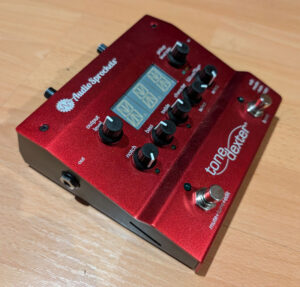
ToneDexter
Of course I can use ToneDexter also for low-volume amplification scenarios, but my strategy is simplicity. I avoid using ToneDexter unless it becomes necessary.